Being a parent on a 45 minute shopping trip can be stressful but a 21 hour + itinerary can turn into a nightmare. Each age is unique and we have taken our kids at pretty much every stage to see our family on the other side of the world.
We are only 4,000 miles away from the majority of our family but we are cheap so we tend to fly through one or two 'hubs' which adds the extra time.
Understanding the different seating scenarios for traveling with multiple children and having a plan can make a huge difference. Also see my posts about traveling pregnant and breastfeeding, expressing and postpartum recovering and being delayed overnight. For packing see the Super Dad Pack and how to alter a jacket to make a travel jacket/vest.
We are only 4,000 miles away from the majority of our family but we are cheap so we tend to fly through one or two 'hubs' which adds the extra time.
Understanding the different seating scenarios for traveling with multiple children and having a plan can make a huge difference. Also see my posts about traveling pregnant and breastfeeding, expressing and postpartum recovering and being delayed overnight. For packing see the Super Dad Pack and how to alter a jacket to make a travel jacket/vest.

0-6 months
- Most useful item: swaddling blanket which is good for
- making baby feel warm and cuddled in travel cot or arms
- good substitute for a nursing shawl
- lightweight
- fold small so it's easy to pack a few
- can be used as a diaper changing mat if normal mat cannot be found
- great for mopping up
- spit up
- diaper leaks
- and other spills like older brother's juice
- Another critical item at this stage: backup shirts or easy-to-scrub-clean clothes, like jeans, for the parents. Baby always manages to spit up on you when least expected.
- Pacifier if you can get baby used to it before the trip. I knew a mom who used to teach her babies associations with a pacifier or special toy so on the flight when she handed over the teddy or whatever, the babies would be clued to sleep.
- On the upside baby doesn't move around too much
- Mostly wants to breastfeed
- A baby of this age might even want to sleep on the flight - if this happens take a nap. The advice Sleep when your baby sleeps has never been so relevant. You need to have your wits about you for the next leg or legs of travel, immigration officers, etc. Even if your husband is wrestling with a tantrumming toddler and you feel guilty you have the 'easy' one, just block it out and go to sleep. Trust me - it's not worth trying to swap because the baby will wake up when you try to change arms and then you'll all be in trouble.
- Flight crew and others give more attention the younger baby is
- More likely to get bulkhead seat which is useful for
- toddlers who want to sleep on a flat surface - aka the floor
- breastfeeding
- having somewhere to put baby so not holding in sweaty arms for whole trip
- more legroom
- less likely for baby to be crushed on lap when your tray is down and the person in front decides IN THE MIDDLE OF DINNER BEING SERVED to lean their seats back without warning. The time this happened to us, my 18 month old threw up in the aisle.
- This is a tiring age for the whole family. The new baby will probably wake everyone up at least once in the night before, during and after your trip.
- So try to shorten your trip as much as possible by taking family/friends up on pick up or drop off offers or getting a taxi if you can afford it to and from the airport. We have the option of taking a 1.5 hour bus or a 30 minute taxi ride to the airport but we feel it is more important to minimize travel time as much as possible.
- baby can ride in a front carrier - which is easier to get around an airport with escalators than a buggy would be, and saves waiting around for the buggy in Baggage Reclaim later. Just do not make my mistake of taking a 5 foot long wrap sling - it's difficult to tie on in the cramped confines of an airpline while everyone including you is frantic to make a connection. Get one of those clippy ones - but not Baby Bjorn as it can cause hip problems with baby.
- Your comfort and stress levels are probably going to affect your baby's so try to think of yourself when packing as well. You probably can't take Dramamine or your usual travel meds as you're breastfeeding, so explore other ways to handle motion sickness like motion sickness bracelets and eating icecream - my favorite coping mechanism.
 |
| homemade swaddling blanket - I turned some charity shop sheets into a few extra for our trip! |
7-9 months
- Most useful item: books - you only need about 3 picture books because they'll listen to the same ones over and over. If you have a kindle, try loading a ton of books for the kids on it.
- Finger foods
- Pacifier if baby if used to it - and backups
- We forgot nappy ointment and baby ended up with the worst rash of his life by the time we touched down - so don't skimp on packing the diaper rash cream!
- Down side of this age: baby sleeps less
- Feeds less
- Not old enough to take normal milk so you have to breastfeed or bring formula and sample some at security. If you are bringing formula, consider decanting formula powder into zip lock bags to save space. Another space saver is to order formula ahead to your destination or ask your family abroad to stock up on it for you.
- Taking less breastmilk (due to introduction of solids or part/total weaning) or baby is a more efficient feeder so more time to play rather than feed
- Baby wiggles more
- Baby has short attention span
- Harder to change nappies in a confined space as baby is bigger
- Immunizations: regular immunizations are scheduled without regard to your travel plans. I would always recommend rescheduling an immunization shot so it doesn't happen the day before or even the month before travel. My children often weren't themselves for a week or two after shots - more fussy and more likely to run a temperature. It seems cruel to make them travel when they're already struggling with their shots.
- Baby can ride in a front carrier but is a lot heavier - we ditched the carrier for just juggling between parents at this age
- More likely to have cold or ear infection - due to babies being masters of sharing toys they've drooled on and exploring the world with their mouths. Even having a slight cold when traveling can make baby irritable. If they have an ear infection and are taking antibiotics, they can become monsters - and the antibiotics may cause really terrible poos.
- Most moms I know take their kids out of normal activities a week or two prior to their trip to avoid catching anything.

9 months-2 years
- Most useful item: medicine, not because it works too well but because it's the first thing people ask you if you have a screaming child.
- A note about medicine: This is a hot topic and some people say they would never do this. One mom I know gives children's paracetamol and children's cough medicine with a sleepy side effect, and alternates paracetamol/Tylenol with ibuprofen every four hours. Another mom uses Phenergan but please note this was thought to have caused deaths in several small children a few years ago and is not recommended for children under the age of two! I have never tried it. It's not even produced in the UK - there is a drug with the same name but it is apparently not the same thing and a lot less dangerous.
- I notice my kids will usually not sleep on daytime flights unless they were up all night the night before. On night flights, they tend to sleep an extra hour or two. I never manage to get the kids to sleep more than 4 hours on a 9 hour flight. They usually sleep on our second flight and always in the taxi home.
- Our favorite toy in this age range was reusable stickers. My son loved cars so I told him stories about the cars we stuck and moved around this book.
- Snacks are a great way to pass the time. One lady online suggested you make trail mix with things you know your kids don't like to keep them busy picking out and sorting out for example all the raisins. Another favorite was crackers and breadsticks, which were comfortingly familiar and didn't cause too much mess or excess waste.

- They are still technically a lap baby but bigger, heavier, more curious
- You get less attention from flight crew
- Your child does not have enough attention span to focus on anything for longer than five minutes
- Your child can technically go in a back carrier but is really heavy and doesn't really like being immobilized. A buggy can really slow you down - whether by forcing you to wait for lifts/elevators or in Baggage Reclaim. At this age, they are not old enough for a trunki - we tried and our 18 month old fell off the back and hit his head on the marble floor of Amsterdam Airport.
- Your child is probably walking and may want to spend the whole flight walking up and down the aisles.
- Basically the worst age to travel but you want to take advantage of not having to buy an extra ticket for as long as possible.

 |
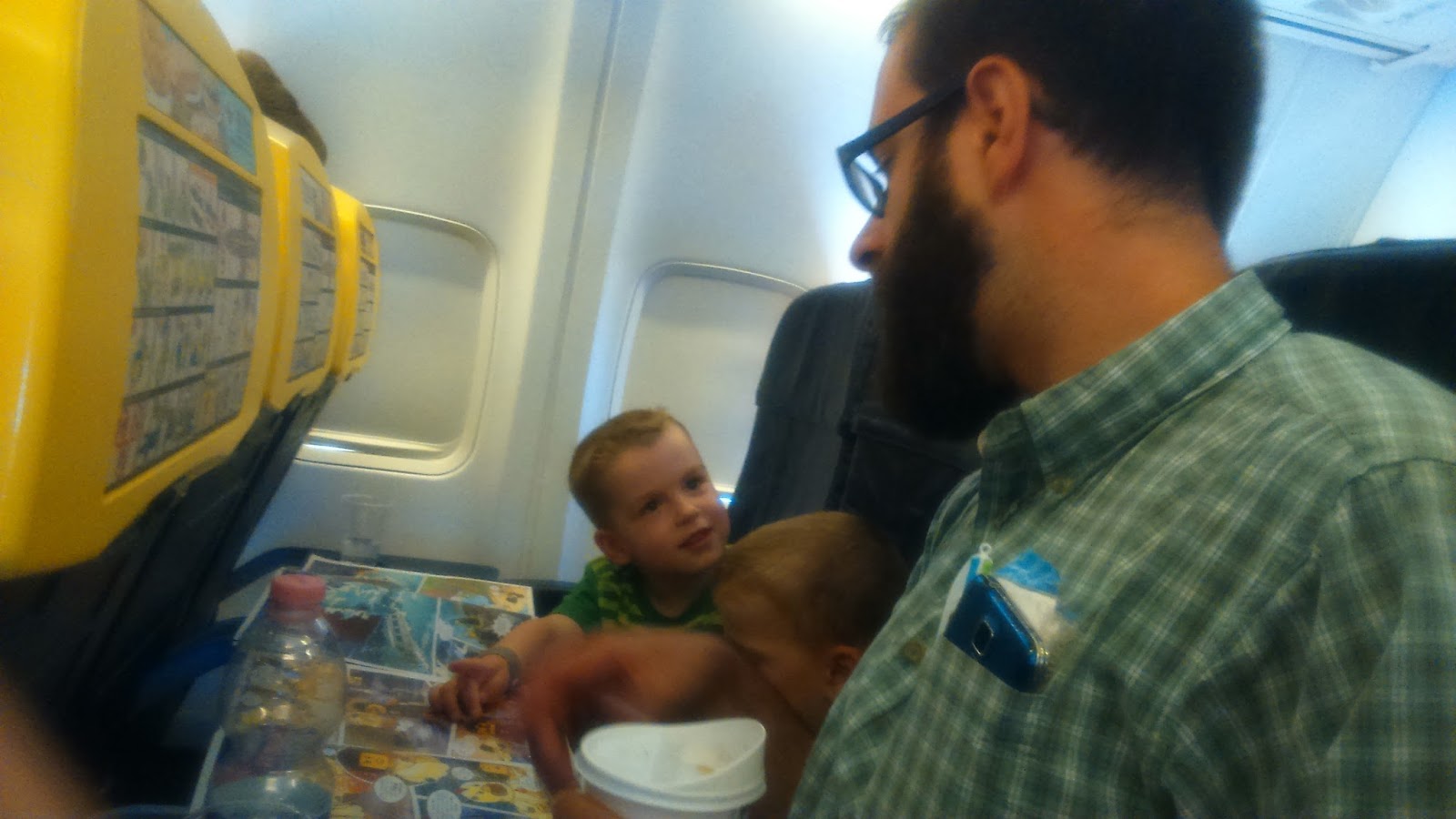
| We end up chasing kids this age up and down aisles most of the trip |
2-4 years
- Most useful items:
- Candy for bribery
- children's magazines
- sticker books
- small figurines - NEW toys are best - and wrapped as presents are even better
- children's headphones - the ones they give out have no audio control and could damage the kids' ears
- trunkies to ride on but most of all to have some visible area to park the kids during all the standing around in queues/lines
- an ipad/kindle/phone with kid games/apps on it
- Kids this age have a better attention span for watching movies or playing games
- Also better at bathroom routine. I don't even try to toilet train till my kids are 3 but some 2-year-olds can be convinced to stand for diaper changing which saves toting a changing mat
- Many kids this age can tell you what is hurting or what's wrong
- Most kids with one foreign parent have been on enough trips by this age to know what to expect - to the point of manipulating the situation sometimes ('I want a window seat like last time!')
- They are capable of sitting still longer
- Snacks are still a good idea - esp if one kid insists on eating only icecream for dinner, it's good to be able pull out something healthy and filling later
- For children who have technically toilet trained but still have accidents, we think it's okay to put them in pull-ups. Give yourself some peace of mind.
- A child of this age can walk more and be more patient in queues/lines
- Their passports haven't expired yet - kids get 5 years before needing renewals.
- This is the best age to travel
- But you have to pay for a seat for them.
Buying tickets before the baby is born
We have been in the interesting situation of buying tickets for the family before the new baby was born with the idea that we would pay for an extra lap baby ticket (which is usually just taxes - for us it was $120) on the day of departure. You cannot buy a ticket for a child without a name and birth date.At our airport, in Edinburgh, they had a clueless person on the desk and overrode our first lap baby's ticket with the second so we almost missed our flights to and from the States because no one could find boarding passes for both our kids.
On the return flight we had to buy baby a new ticket a second time! It was eventually refunded but it was stressful.
We have never flown with two kids under the age of two since so I do not know if this is common or not. Either way, arrive at least an extra hour earlier than you would have if you are buying a ticket even for a baby!
¬¬¬¬¬¬¬¬¬¬¬¬¬¬¬¬¬¬
It can be a meaningful experience to introduce your children to your extended family in a foreign country but often the transatlantic trip can pose a real challenge. A knowledge of children's ages and stages and possible hurdles with buying tickets can be key to planning a successful trip.


